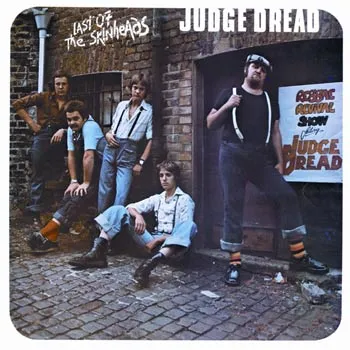
Judge Dread
Born
2 May 1945, Snodland, Kent, United Kingdom
Died
13 March 1998, Canterbury, Kent, United Kingdom
Also Known As
Alexander Minto Hughes, King of Rudeness
Genres
Share
Follow
171 followers
ADVERTISEMENT
Discography
138Album
Showing all (8)
Issues
Reviews
Title
/
Release Date
ADVERTISEMENT
Live Album
Showing all (1)
Issues
Reviews
Title
/
Release Date
EP
Showing all (3)
Issues
Reviews
Title
/
Release Date
Single
Showing all (25)
Issues
Reviews
Title
/
Release Date

Appears On
Showing all (5)
Issues
Reviews
Title
/
Release Date
Compilation
Showing 11 of 24
Issues
Reviews
Title
/
Release Date
V/A Compilation
Showing 10 of 51
Issues
Reviews
Title
/
Release Date
Songs
resist_retreat
"Alex Hughes was a familiar character in Britain’s original skinhead culture, earning a living as a professional wrestler, debt collector for Trojan Records, bouncer at London’s West Indian clubs, and occasional bodyguard for visiting luminaries such as Coxsone Dodd and Duke Reid. But it was to Prince Buster that Hughes owed both his stage name and his original success. Besotted with Buster’s “Big Five”, Dread, now working as a DJ with his own sound system, recorded his own “Big Six,” basically an x-rated nursery rhyme which stayed on the charts for half a year with no airplay whatsoever, even crossing over into the Jamaican market, where audiences were astonished when Judge Dread turned out to be a burly white guy from the Garden of England. It also established Dread’s character, resulting in a string of chart-bound innuendo in spite of a near universal ban from “respectable” broadcasters. Bawdiness, though, has a history as an essential part of British culture. Dread’s curious hybrid of reggae and music hall was made explicit by the cover of George Formby’s “Grandad’s Flannelette Nightshirt” on Working Class ‘Ero, and official disapproval of his music resulted in the longest run of singles banned by the BBC. This recalls feminist campaigns against the “lewd” content of music hall shows back in the late 1800s (incidentally occasioning Winston Churchill’s first political speech, protesting the “Prudes on the Prowl,” who had caused the erection (sic) of screens around the Empire Theatre in Leicester Square). The strong class element of Dread’s music means that what may have become dated still stands in stark opposition to middle class pieties; it’s just offensive for different reasons. Dread’s hybrid also makes him perhaps the unlikeliest of bridges between old England and new England; a cheeky chappy carrying on skanking. But more than anything, Alex Hughes’ genius lay in the character he created; one who for all of his oversized slackness lived more in hope than expectation, whose point of comedic identification lay in his endearing fallibility, if not ridiculousness. More importantly, the irrepressible nature of the music makes it damned near irresistible."
RYM Rough Guide for Judge Dread
Biography
Judge Dread was the first white reggae artist to have a hit in Jamaica and most of his UK hits were banned from the radio because of the explicit and rude content.
13 Lists
Shows
ADVERTISEMENT
Contributions
Log in to submit a correction to this page.